August 11th, 2026
Why Non-Woven Wipers Are Becoming a Go-To Choice for Industrial Cleaning
For businesses that depend on reliable cleaning and maintenance supplies, choosing the right wiping product can directly affect efficiency, surface cleanliness, and day-to-day operations. Coastal Wipers provides a broad range of professional wiping solutions, including non-woven wipers, disposable products, microfiber cleaning materials, rags, towels, and industrial sorbents for different workplace applications. As manufacturers, automotive facilities, maintenance teams, food-service operations, and other businesses look for consistent and effective cleaning solutions, non-woven wipers are increasingly becoming a practical choice because of their combination of absorbency, strength, versatility, and low-lint performance.
Unlike traditional woven fabrics, non-woven materials are manufactured by bonding or entangling fibers rather than weaving threads together. This allows manufacturers to develop wiping products with specific performance characteristics for different industrial applications. Depending on the construction, non-woven wipers can provide strong wet and dry performance, absorb liquids efficiently, resist abrasion, and produce relatively little lint.
So, why are non-woven wipers becoming such a popular option for industrial cleaning? And how do they compare with traditional rags and other wiping materials?
Let’s take a closer look.
What Are Non-Woven Wipers?
Non-woven wipers are cleaning materials made from fibers that are bonded or mechanically entangled rather than woven together into a traditional textile.
One common manufacturing method is hydroentangling, also known as spunlacing. In this process, high-pressure water jets entangle fibers to create a cohesive material. Depending on the construction, the finished wiper can offer a combination of strength, absorbency, abrasion resistance, and low-lint performance.
This manufacturing flexibility is one reason non-woven wipers are available in many different formats and performance levels.
For example, industrial facilities may use non-woven products for:
- Machinery maintenance
- Oil and grease removal
- Surface preparation
- Spill cleanup
- General equipment cleaning
- Glass and stainless-steel cleaning
- Automotive maintenance
- Manufacturing processes
- Food-service applications
- Sensitive surface cleaning
Some non-woven wipers are intended for heavy-duty applications, while others are designed for light or precision cleaning.
Why Are Non-Woven Wipers Growing in Popularity?
Industrial cleaning requirements are changing. Businesses want cleaning products that can do more than simply wipe a surface.
They need materials that are consistent, convenient, durable, absorbent, and appropriate for the specific application.
Non-woven wipers can provide many of these characteristics in a single product category.
Coastal Wipers describes its non-woven products as serving industries such as automotive manufacturing, food and beverage, pharmaceutical manufacturing, and other applications where specific cleaning characteristics are important.
Several factors are driving their popularity.
1. Consistent Construction
Traditional recycled rags can vary in material, thickness, texture, and size because they may come from different textile sources.
Non-woven products, by contrast, are manufactured according to defined specifications. This can give businesses greater consistency from one package or order to another.
For facilities where predictable wiping performance matters, that consistency can be valuable.
2. Strong Absorbency
Many non-woven wipers are designed to absorb liquids effectively.
This can make them useful for cleaning:
- Water
- Oil
- Grease
- Coolants
- Lubricants
- Cleaning solutions
- Other workplace liquids
A more absorbent material can help employees complete spill and maintenance tasks using fewer pieces.
3. Low-Lint Performance
Lint can be a problem in industrial environments.
Loose fibers left on machinery, glass, painted surfaces, components, or finished products can create additional cleaning work or interfere with certain processes.
Many non-woven wipers are designed to offer very low lint compared with some conventional wiping materials. Coastal Wipers specifically identifies low-lint performance among the characteristics of certain non-woven products in its range.
This makes them particularly useful when surface cleanliness matters.
4. Durability
Industrial cleaning can be demanding.
Employees may need to wipe rough equipment, tools, machinery, work surfaces, and components covered in grease or other contaminants.
A wiper that falls apart during use can increase material consumption and slow down the task.
Certain non-woven wipers are engineered for strong wet and dry performance, allowing them to maintain their integrity during demanding cleaning applications.
Non-Woven Wipers vs. Traditional Shop Rags
One of the most common questions businesses have is whether they should use non-woven wipers or traditional shop rags.
The answer depends on the task.
Traditional shop rags can be an excellent option for general maintenance, heavy-duty wiping, and applications where reusability and absorbency are priorities.
Non-woven wipers can be preferable when businesses need:
- More consistent construction
- Lower lint
- Specialized absorbency
- Disposable convenience
- Predictable performance
- Specific surface-cleaning characteristics
For example, a mechanic cleaning a heavily greasy machine may be perfectly satisfied with a durable cotton rag. A facility cleaning a sensitive finished surface may prefer a low-lint non-woven product.
In many workplaces, the best approach is to use both.
Disposable Industrial Wipers for Convenient Cleanup
One of the major advantages of non-woven materials is that many are available as disposable industrial wipers.
Disposable products can be particularly useful when contamination control and convenience are priorities.
Instead of collecting, laundering, and returning a used cloth, employees can use the wiper for the intended task and then follow the facility’s appropriate waste-handling procedures.
Disposable industrial wipers can be useful for:
- Heavy contamination
- Oil and grease cleanup
- Production-line maintenance
- Surface preparation
- Spill response
- High-frequency cleaning
- Tasks where cross-contamination needs to be minimized
This can simplify workplace cleaning processes.
However, disposable does not automatically mean better. Businesses should consider material consumption, waste handling, and the requirements of each application before choosing disposable products.
Non-Woven Cleaning Cloths for Different Applications
The term non-woven cleaning cloths covers a wide variety of products.
Different constructions can provide different levels of absorbency, texture, strength, and lint performance.
Here are some common applications.
Manufacturing
Manufacturing facilities frequently need wiping materials for machinery, production equipment, tools, workstations, and components.
Non-woven cleaning cloths can provide a consistent option for routine maintenance.
For applications involving oil, grease, or lubricants, businesses may select absorbent materials designed for industrial maintenance.
Automotive
Automotive manufacturers, repair facilities, and maintenance shops deal with oil, grease, coolant, dirt, dust, and other contaminants.
Non-woven wipers can be used for equipment cleaning, parts wiping, surface preparation, and general maintenance.
Coastal Wipers notes that its non-woven products are used by auto manufacturers for applications where effective wiping without scratching is important.
Pharmaceutical Manufacturing
Pharmaceutical manufacturing environments can have stringent cleanliness requirements.
In these applications, businesses may prioritize wiping products that provide low-lint performance and predictable construction.
Coastal Wipers identifies non-woven materials among the products used by pharmaceutical manufacturers for lint-free performance.
Food and Beverage
Food-related operations require careful attention to cleaning practices and contamination control.
Some non-woven products are specifically designed for food-service and food-manufacturing applications. Certain spunlace products can provide wet strength and durability, while color-coded options can help organizations establish cleaning zones and reduce cross-contamination risks.
Businesses should always select products appropriate for their specific facility and follow applicable food-safety procedures.
Glass and Smooth Surfaces
Some non-woven materials are designed for glass, mirrors, stainless steel, and other smooth surfaces.
For example, Coastal Wipers describes scrim non-woven products as low-cost, low-lint materials intended for glass, mirrors, stainless steel, and smooth-surface cleaning.
This illustrates why choosing a wiper based on the specific application is important.
The Importance of Low-Lint Wipers
For some industrial applications, lint isn’t just an inconvenience.
It can affect the cleanliness of a surface or require additional cleaning after the wiping process.
Low-lint industrial cleaning wipes can be useful when working with:
- Glass
- Stainless steel
- Precision components
- Finished products
- Sensitive machinery
- Manufacturing equipment
- Controlled environments
The exact lint performance required will depend on the application.
Businesses should review product specifications rather than assuming every non-woven wiper has identical lint characteristics.
Non-Woven Wipers and Surface Preparation
Surface preparation is another important application.
Before painting, coating, assembly, finishing, or other processes, workers may need to remove dust, oil, debris, or other contaminants.
A suitable non-woven wiper can help clean the surface without introducing excessive lint.
For automotive, manufacturing, and fabrication environments, this can be particularly useful because surface cleanliness can affect the quality of subsequent work.
The right wiper should be selected according to the surface and the material being removed.
Are Non-Woven Wipers Reusable?
Some non-woven wipers can be reused depending on their construction and intended application, while others are specifically designed for disposable use.
For example, Coastal Wipers describes certain hydroentangled spunlace products as reusable, while also offering non-woven disposable wipers as part of its product range.
Whether reuse makes sense depends on:
- The level of contamination
- The cleaning task
- The material construction
- Laundering capabilities
- Workplace hygiene requirements
- Cross-contamination concerns
- Total cost of use
A business should not assume that every non-woven wiper should be discarded after one use or that every product is suitable for repeated laundering.
Always follow the manufacturer’s product guidance.
How Non-Woven Wipers Can Improve Cleaning Efficiency
A good wiping program isn’t just about keeping surfaces clean. It can also improve productivity.
Consider a maintenance worker who needs to clean a machine covered in oil.
If the selected cloth has poor absorbency, the worker may need multiple pieces. If it tears easily, additional material may be required. If it leaves excessive lint, another cleaning step may be necessary.
A suitable industrial wiper can potentially reduce these inefficiencies.
Benefits can include:
- Faster cleanup
- Better liquid absorption
- Fewer replacement pieces
- More consistent results
- Less lint
- Easier inventory management
- Improved worker convenience
The actual benefit depends on choosing the correct product for the task.
Choosing the Right Non-Woven Wiper
Not all non-woven wipers are identical.
When selecting a product, consider the following factors.
Absorbency
Determine whether the wiper needs to absorb water, oil, grease, solvents, or other liquids.
Strength
For heavy-duty maintenance, select a material capable of withstanding the required wiping pressure and surface conditions.
Lint
If surface contamination is a concern, prioritize a product with appropriate low-lint characteristics.
Texture
Textured materials can be useful for capturing dirt and particles, while smooth products may be better for certain finished surfaces.
Size
Larger wipers may be useful for large spills and equipment. Smaller formats can be more convenient for detailed tasks.
Disposable vs. Reusable
Decide whether the facility’s cleaning process is better suited to disposable or reusable materials.
Packaging
Consider whether your employees need rolls, pop-up dispensers, folded products, or other formats that make distribution easier.
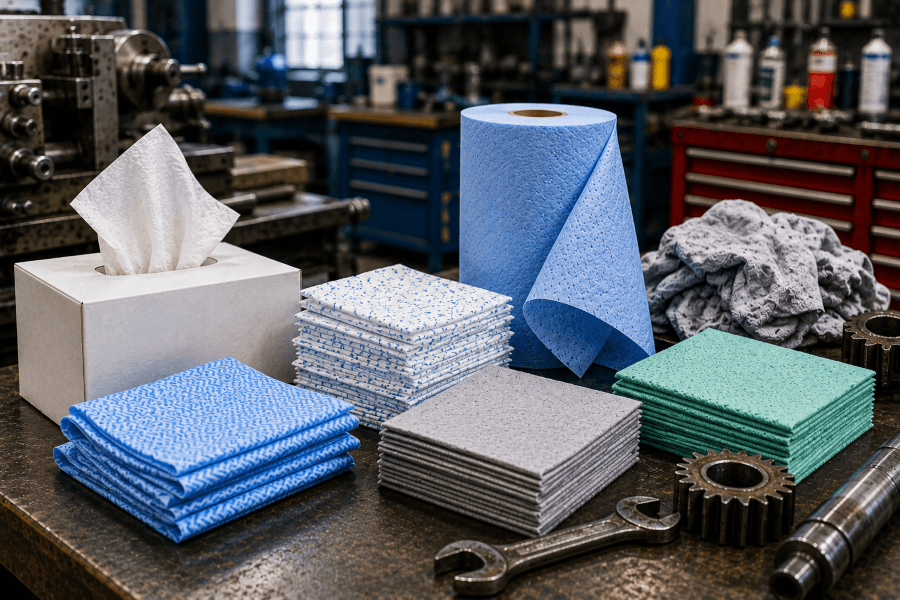
Coastal Wipers offers non-woven products in several formats, including rolls, pop-up packaging, and folded configurations depending on the product.
Common Types of Non-Woven Wipers
The non-woven category includes several different materials and constructions.
Hydro-Entangled Spunlace
These wipers are known for combinations of strength, absorbency, abrasion resistance, and low-lint performance. They can be used across a wide variety of industrial cleaning applications.
DRC Wipers
DRC products can provide a soft, cloth-like feel combined with absorbency and durability, making them useful as general-purpose wipers.
Scrim Wipers
Scrim products can be useful for light- to medium-duty cleaning, particularly on smooth surfaces such as glass, mirrors, and stainless steel.
Rayon Wipers
Rayon/PET products can offer a textured surface designed for particle pickup and are used in applications including automotive cleaning.
Tack Cloths
Tack cloths are treated to capture and hold dust, making them useful for applications where controlling airborne dust and surface particles is important.
The important takeaway is that businesses should select a non-woven wiper according to its construction and intended application rather than treating all non-woven products as interchangeable.
Non-Woven Wipers and Workplace Hygiene
Cleaning materials play an important role in workplace hygiene.
When employees have easy access to appropriate wiping products, they can address spills, contamination, and dirty surfaces more quickly.
Disposable industrial wipers can also make it easier to use a fresh wiping material for specific tasks.
For facilities where cross-contamination is a concern, businesses can establish dedicated products or color-coded cleaning systems for different areas.
This is particularly relevant in food service, healthcare-related environments, manufacturing, and other operations where cleanliness procedures are closely managed.
How to Reduce Wiper Waste
Choosing disposable products does not mean businesses should ignore material efficiency.
A well-managed wiping program can help reduce unnecessary consumption.
Start by determining which tasks actually require disposable wipers.
Then:
- Match wiper size to the job.
- Train employees on proper product selection.
- Store clean wipers in accessible locations.
- Monitor consumption.
- Avoid using specialized products for routine tasks where they are unnecessary.
- Follow appropriate disposal procedures.
- Review product performance periodically.
Tracking usage can help identify whether employees are using too much material or whether a different product would perform better.
Why Businesses Are Turning to Non-Woven Wipers
The growing interest in non-woven wipers comes down to versatility.
A modern industrial facility may need one wiping material for machinery, another for glass, another for sensitive components, and another for high-volume spill cleanup.
Non-woven technology allows manufacturers to produce materials with different combinations of strength, absorbency, texture, and lint performance.
That flexibility makes non-woven products useful across a wide range of industries.
They are not simply a replacement for traditional shop rags. They are another category of professional wiping solution that can fill specific performance needs.
Are Non-Woven Wipers Right for Your Business?
If your business requires consistent, effective wiping materials for cleaning and maintenance, non-woven products may be worth considering.
They can be especially useful when you need:
- Reliable absorbency
- Durable construction
- Low-lint performance
- Consistent material quality
- Disposable convenience
- Specialized cleaning characteristics
- Multiple packaging options
However, the right choice should always be based on the actual cleaning application.
A heavy-duty mechanic may need a different wiper than a pharmaceutical manufacturer. A glass manufacturer may have different requirements from a warehouse. A food-production facility may need different cleaning materials from an automotive shop.
Choose the Right Industrial Cleaning Wipes with Coastal Wipers
Non-woven wipers are becoming a go-to choice for industrial cleaning because they can combine several important performance characteristics in one versatile category. Depending on the construction, they can provide strong absorbency, durability, low-lint performance, surface-friendly cleaning, and convenient disposable or reusable options.
From manufacturing and automotive operations to food and beverage, pharmaceutical, maintenance, and other commercial applications, businesses can select different non-woven products based on their specific cleaning requirements. Coastal Wipers offers non-woven disposable wipers alongside rags, towels, microfiber cleaning products, and industrial sorbents, giving businesses multiple options for building a task-specific wiping program.
The key is to avoid treating every cleaning task the same. Consider the contaminant, surface, absorbency, lint requirements, durability, size, and disposal or laundering process before selecting a product.
When the right wiping material is matched to the right job, cleaning can become more efficient, consistent, and manageable.
