August 11th, 2026
Industrial Wipers vs. Shop Rags: Which Cleaning Solution Is Right for Your Business?
When it comes to keeping a workplace clean, safe, and productive, Coastal Wipers provides businesses with practical wiping solutions designed for a wide range of industrial and commercial applications. But with so many options available, one common question remains: industrial wipers vs. shop rags—which cleaning solution is right for your business? Both industrial wipers and shop rags can be useful for wiping oil, grease, dirt, chemicals, dust, and other contaminants, but they differ in material, performance, consistency, absorbency, durability, and ideal applications. Understanding these differences can help your business choose the right wiping cloths while controlling costs and maintaining workplace standards.
Industrial Wipers vs. Shop Rags: Understanding the Difference
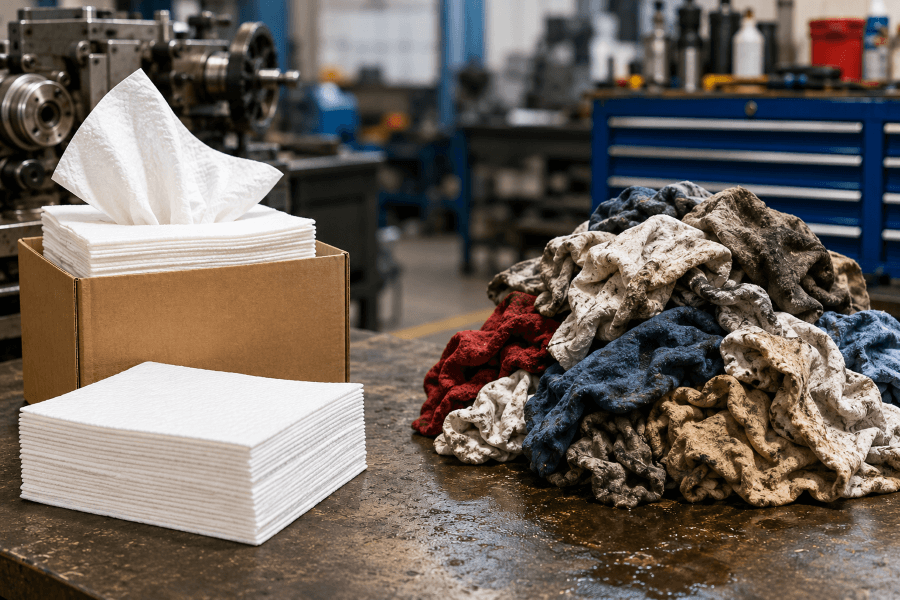
At first glance, industrial wipers and shop rags may appear to serve the same purpose. Both are used to wipe surfaces, clean equipment, absorb spills, and remove contaminants. However, their construction and intended applications can be significantly different.
Shop rags are generally reusable cloths made from recycled textiles or other fabric materials. They are commonly used in automotive shops, manufacturing facilities, maintenance departments, machine shops, and general-purpose workplaces.
Industrial wipers, on the other hand, are specifically manufactured or processed for demanding wiping applications. Depending on the type, they may be made from non-woven materials, specialized fabrics, microfiber, or other engineered materials designed to provide predictable absorbency, strength, and cleaning performance.
The best option depends on what your employees are cleaning, how frequently wiping is required, the type of contaminants involved, and whether consistency is important to your operation.
What Are Industrial Wipers?
Industrial wipers are cleaning materials designed for professional and industrial environments. They can be used for everything from wiping machinery and tools to cleaning workstations, removing grease, absorbing liquids, and preparing surfaces.
Unlike ordinary household cleaning cloths, industrial wipers are intended to withstand the more demanding conditions found in factories, warehouses, automotive facilities, maintenance shops, and other workplaces.
Industrial wipers may include several different categories, such as:
- Non-woven disposable wipers
- Microfiber wipers
- Heavy-duty industrial wipers
- General-purpose wiping cloths
- Low-lint wipers
- Specialty cleaning materials
One of the major advantages of industrial wipers is consistency. Businesses often need a wiping product that performs predictably from one task to another. Industrial wiping products can provide a more uniform material, making it easier for employees to follow established cleaning procedures.
For facilities where contamination control, lint reduction, or reliable absorbency matters, the right industrial wiper can provide significant advantages.
What Are Shop Rags?
Shop rags are reusable or recycled cloths commonly used for general cleaning and maintenance tasks. They have been a staple in automotive repair shops, manufacturing facilities, garages, and mechanical environments for decades.
Shop rags can be made from a variety of textile materials. Some are cut from recycled clothing or other fabric sources, while others are manufactured specifically as reusable shop towels.
Their biggest advantage is versatility. A shop rag can be used to wipe grease from a tool, clean a workbench, dry a component, or absorb a small spill.
However, the quality and characteristics of shop rags can vary considerably. Different batches may contain different fabric blends, thicknesses, textures, and absorbency levels. For some applications, this variation may not matter. For others, consistency can be critical.
Industrial Wipers vs. Shop Rags: Key Differences
When comparing industrial wipers vs shop rags, businesses should consider several factors rather than focusing only on the initial price.
1. Consistency
Consistency is one of the biggest differences between industrial wipers and traditional shop rags.
Because shop rags can be made from recycled textiles, their size, thickness, texture, and absorbency may vary. One rag may be thick and highly absorbent, while another may be thinner or have a different texture.
Industrial wipers are often manufactured or processed with specific performance characteristics in mind. This can make them a better choice when employees need predictable wiping performance.
For standardized cleaning procedures, industrial wipers can help businesses maintain greater consistency.
2. Absorbency
Absorbency is important when cleaning up oils, water, solvents, coolant, grease, and other liquids.
Many shop rags offer good absorbency, especially when made from suitable cotton or textile materials. However, absorbency can vary depending on the type and condition of the rag.
Industrial wipers can be selected based on the specific liquid or cleaning task. Some are designed for high absorbency, while others prioritize durability, low lint, or surface cleaning.
Businesses that regularly deal with substantial liquid spills may benefit from selecting wiping products based on the specific absorbency requirements of their operation.
3. Durability
A wiping material needs to hold together during use. This is especially important when employees are wiping rough machinery, metal components, tools, or industrial equipment.
Shop rags can be highly durable, but performance depends on the fabric. Repeated laundering can also affect the condition of reusable materials.
Industrial wipers are available in different strength levels. Heavy-duty options can be appropriate for demanding wiping applications where tearing or material breakdown could interrupt a task.
The right choice depends on whether the business needs a reusable cloth for repeated tasks or a consistent wiper designed for a particular cleaning application.
4. Lint and Residue
Lint can be a serious concern in certain workplaces.
For general maintenance work, a small amount of lint may not be an issue. However, industries involving sensitive machinery, electronics, precision components, paint preparation, or finished surfaces may need lower-lint wiping materials.
Some shop rags may leave behind fibers, especially if they are made from certain recycled textiles.
Industrial wipers, including specialized low-lint options, can provide a better solution when surface cleanliness and contamination control are priorities.
5. Reusability
One advantage of shop rags is their potential for repeated use. Depending on the material, they can be collected, laundered, and returned to the workplace.
Reusable shop towels can therefore be attractive to businesses that want a wiping solution suitable for repeated maintenance tasks.
Industrial wipers can be either reusable or disposable depending on the product. Disposable wipers can be useful when contamination, convenience, or quick cleanup is more important than repeated use.
The best option depends on the cleaning process and how your facility manages used wiping materials.
When Should Your Business Use Shop Rags?
Shop rags can be a practical choice for many routine maintenance and cleaning applications.
Consider shop rags when your business needs:
- General-purpose cleaning
- Durable reusable cloths
- Automotive maintenance wiping
- Grease and oil cleanup
- Tool and equipment wiping
- Workbench cleaning
- Routine maintenance tasks
- Cost-conscious reusable wiping solutions
For example, an automotive repair facility may use shop rags to wipe oil from tools, remove grease from components, clean workstations, and handle everyday maintenance tasks.
They can also be useful in manufacturing and mechanical environments where the wiping task does not require extremely low-lint or highly standardized materials.
When Should Your Business Use Industrial Wipers?
Industrial wipers may be a better fit when performance consistency, cleanliness, absorbency, or specialized characteristics are important.
Businesses may consider industrial wipers for:
- Manufacturing facilities
- Industrial maintenance
- Machine shops
- Automotive production
- Equipment maintenance
- Oil and grease cleanup
- Chemical handling areas
- Precision cleaning
- Low-lint applications
- High-volume wiping operations
For example, if employees need to clean machinery several times a day, a consistent industrial wiper can simplify the process and reduce uncertainty about the performance of the wiping material.
Shop Towels vs. Industrial Wipers
The terms shop towels and industrial wipers are sometimes used interchangeably, but they can refer to different types of products.
Shop towels are generally associated with reusable cloth products used in workshops, garages, automotive facilities, and maintenance environments. Industrial wipers are a broader category that can include disposable, non-woven, microfiber, and specialized wiping products.
For routine jobs such as wiping tools and machinery, shop towels may be sufficient.
For applications requiring specific performance characteristics, businesses may prefer industrial wipers designed for absorbency, strength, low lint, or other requirements.
Rather than choosing based solely on the product name, consider the actual cleaning task.
Disposable Wipers vs. Reusable Shop Rags
Another important consideration is whether your business wants disposable or reusable wiping materials.
Reusable shop rags need to be collected, sorted, transported, and laundered. This adds another step to the cleaning process.
Disposable industrial wipers can be used and then discarded according to your facility’s waste-management procedures. This can make them convenient for tasks involving heavy contamination or situations where cross-contamination is a concern.
However, disposable does not automatically mean better. Businesses should evaluate the full cost and environmental considerations associated with their wiping program.
A reusable product may make sense for repetitive, relatively clean maintenance work, while disposable industrial wipers may be more practical for contaminated or high-volume applications.
Cost Considerations: Which Option Is More Affordable?
When comparing industrial wipers vs shop rags, the lowest purchase price does not necessarily represent the lowest overall cost.
Shop rags may appear inexpensive because they can be reused. However, businesses should consider laundering, transportation, storage, replacement, labor, and potential material loss.
Industrial wipers may have a higher cost per individual piece, but they can offer predictable performance and convenience. In some applications, that can translate into less material waste and faster cleaning.
A useful way to evaluate costs is to consider cost per completed cleaning task, rather than simply cost per cloth.
Ask questions such as:
- How many wipers are needed for each task?
- How often can a reusable rag be safely reused?
- What does laundering cost?
- How much employee time is spent handling used rags?
- Does the wiping material leave lint or residue?
- Does inconsistent performance result in repeated cleaning?
- Is the material strong enough to complete the job without tearing?
This broader calculation can help your business identify the most economical solution.
Safety and Workplace Cleanliness
Wiping materials also play a role in workplace safety.
Oil, grease, solvents, and other substances can create slippery surfaces or contribute to unsafe working conditions if they are not cleaned properly.
Using the appropriate wiping material can help employees clean spills and contaminated surfaces efficiently.
Businesses should also establish procedures for handling and disposing of used wiping materials, especially when they have been exposed to chemicals, oils, solvents, or other potentially hazardous substances.
Employees should follow applicable safety procedures, product instructions, and workplace regulations when handling contaminated wiping materials.
Choosing the Right Wiping Cloth for Your Application
There is no single wiping solution that is ideal for every business. The right choice depends on the specific application.
Before purchasing wiping cloths, evaluate the following:
Type of Contaminant
Are employees cleaning water, oil, grease, coolant, chemicals, dust, or dirt?
Different materials perform differently depending on the substance being removed.
Surface Type
Consider whether employees are wiping metal, glass, plastic, painted surfaces, machinery, tools, or sensitive components.
Lint Requirements
If lint or fiber residue can affect the finished product or equipment, consider low-lint industrial wipers or other specialized options.
Frequency of Use
A business that uses hundreds or thousands of wiping materials every week may need a different solution than a small shop that only uses a few cloths each day.
Reusable vs. Disposable
Determine whether your operation benefits more from laundering reusable shop rags or the convenience of disposable wipers.
Storage and Handling
Think about how clean wiping materials will be stored and how used materials will be collected. An organized wiping system can make cleaning faster and easier for employees.
Why Businesses Need the Right Industrial Wipers
The right industrial wipers can do more than simply remove dirt. They can support efficient maintenance procedures, improve cleaning consistency, and help employees complete tasks without wasting materials.
For facilities with specialized cleaning requirements, choosing the correct type of wiper is particularly important.
For example, microfiber may be appropriate when businesses need effective surface cleaning and reusable performance. Non-woven wipers may be useful when consistent, disposable wiping materials are preferred. Industrial sorbents can be better suited for managing larger spills and absorbing liquids.
This is why businesses should consider their specific cleaning challenges before selecting a product.
How Coastal Wipers Can Help
Coastal Wipers offers a range of wiping solutions designed to support commercial, industrial, maintenance, and cleaning applications.
Its product categories include rags, towels, and wiping cloths, non-woven disposable wipers, microfiber cleaning products, and industrial sorbents. This variety allows businesses to consider different wiping materials based on their cleaning requirements rather than relying on a one-size-fits-all approach.
Whether your facility needs reusable shop rags for everyday maintenance, disposable industrial wipers for consistent cleanup, microfiber products for specialized surface cleaning, or industrial sorbents for spill management, selecting the right material can make a meaningful difference in your cleaning process.
Businesses interested in exploring their options can visit Coastal Wipers to learn more about available wiping solutions and find products suited to their specific applications.
Industrial Wipers vs. Shop Rags: Which One Should You Choose?
So, industrial wipers vs shop rags—which is better?
The answer depends on your business.
Choose shop rags when you need durable, reusable cloths for general maintenance, automotive work, tool cleaning, grease removal, and everyday shop tasks.
Choose industrial wipers when you need consistent performance, specialized materials, predictable absorbency, low-lint characteristics, or convenient disposable options.
In many workplaces, the best strategy may actually be to use both. Shop rags can handle routine maintenance tasks, while specialized industrial wipers can be reserved for applications where consistency, cleanliness, or performance is especially important.
Instead of asking which product is universally better, ask which wiping solution is best for each task.
Conclusion
Choosing between industrial wipers and shop rags is an important decision for businesses that depend on regular cleaning and maintenance. While shop rags offer versatility and reusability, industrial wipers can provide greater consistency and specialized performance for demanding applications.
Factors such as absorbency, durability, lint, reusability, contamination, cleaning frequency, and overall operating costs should all be considered before making a decision.
For businesses looking for reliable industrial wipers, shop towels, wiping cloths, microfiber cleaning products, and industrial sorbents, Coastal Wipers offers multiple options to meet different workplace requirements.
The goal is not simply to find the cheapest cloth. It is to choose a wiping solution that helps your employees clean efficiently, supports your maintenance procedures, and delivers the performance your business needs.
